Hi everyone,
As part of the AI/ML Special Interest Group (SIG) under the International Society of Pharmacometrics (ISoP), we had the opportunity to organize a panel discussion on the use cases and regulatory considerations of AI/ML in pharmacometrics and clinical pharmacology. I was delighted to co-chair the session with Victoria Ponce, alongside our distinguished panelists, Hao Zhu, Flora Musuamba, and James Lu. For those who couldn't join, we'd like to share a short summary of the discussion and what it might mean for our community.
Snapshot
-
Rapid adoption: AI/ML-related submissions to FDA grew from ~1 per year (2016) to ~500 per year (2025); oncology leads, then gastroenterology and neurology/psychiatry.
-
Where the room stood (live poll): ~50% using AI/ML internally, ~37% piloting/exploring, only ~4% had contributed AI/ML to a regulatory submission.
The headline
-
There is not a separate "AI checklist": Regulators assess it like any other method by the question it answers and the risk to patients, not by the algorithm.
-
The guidance has converged. EMA, FDA, a joint FDA-EMA set of principles, and ICH M15 now point in the same direction.
Regulators converged (2024–2026)
-
EMA Reflection Paper on AI in the medicinal-product lifecycle, final, Sep 2024 (risk-based, whole lifecycle).
-
FDA draft guidance on AI to support regulatory decision-making, Jan 2025 (a 7-step, risk-based credibility framework tied to the context of use).
-
Joint FDA-EMA Guiding Principles of Good AI Practice in Drug Development, Jan 2026 (10 principles: human oversight, risk management, data governance, transparency, lifecycle).
-
ICH M15 (General Principles for Model-Informed Drug Development), June 2026 (AI assessed as any other MIDD tool within ICH M15 guideline; question of interest → context of use → model risk).
What we discussed, key takeaways
-
Start from the question, not the tool. Define the context of use and ask "what would we do without AI?" Risk scales the evidence required; there is no universal pass-mark; and the bar is not lowered relative to PopPK/PBPK/QSP.
-
Evaluation is everything. A credible submission shows the data, the model development, and, above all, model evaluation and performance. Report per ICH M15; demonstrate robustness (not cherry-picked results) and reproducibility (seeds, configurations).
-
Performance vs. interpretability. Predictive performance often takes priority, but transparency and explainability drive trust and adoption. Transparency ≠ full explainability, declare what you cannot explain and bound it with worst-case and sensitivity analyses.
-
GenAI and agents need guardrails. Control non-determinism, mitigate hallucination, and keep a human in the loop; mandatory, but it means owning the final decision, not checking every line. Favor auditable pipelines where every tool call is logged.
-
Manage the whole lifecycle. Preserve key qualification across versions, run a risk-based re-assessment on changes, and monitor for performance and data drift after deployment.
-
Where AI adds value, now and next. Now: efficiency and orchestration, data aggregation, flexible structural models, covariate selection, faster QSP setup. Next: collaborating agents and decision support in today's gray zones (pediatric/preterm, rare and slowly-evolving diseases), provided the tools are validated.
The one thing to remember
The bottleneck has shifted from building AI to evaluating it. Evaluation is a shared responsibility: developers know their tools best, so build assessment in parallel with development rather than waiting for regulators to ask.
What this means for you
-
Frame every AI analysis around a question + context of use + model risk.
-
Treat reproducibility and reporting as deliverables (align with ICH M15).
-
Design agentic/GenAI work to be auditable, with a human in the loop.
-
Plan ahead for version control and post-deployment monitoring.
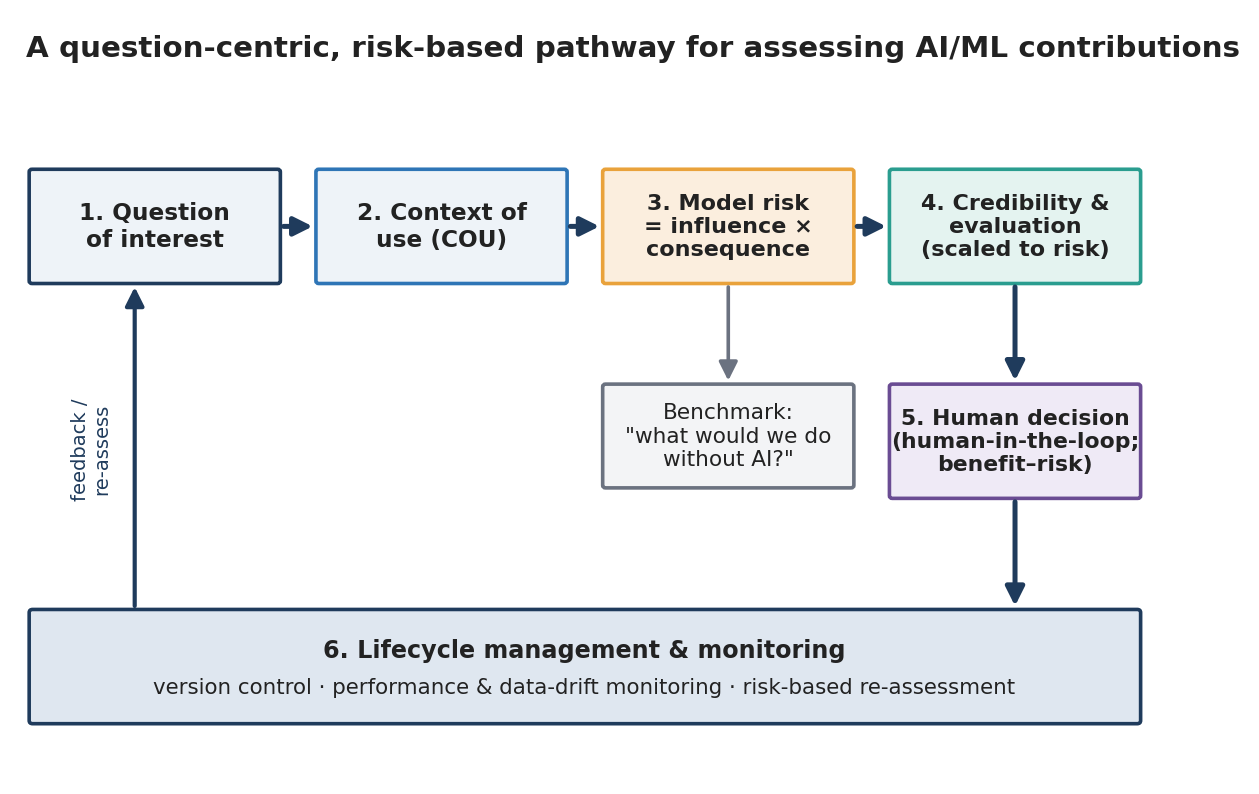
How an AI/ML contribution is assessed: question → context of use → model risk → risk-proportionate evaluation → human decision → lifecycle monitoring.
------------------------------
Ali Farnoud
Principal Scientist
Boehringer Ingelheim Pharma GmbH & Co. KG
------------------------------